
Native Animals
Mammals
Proximity to the cooler, higher environment of the San Juan Mountains meant the Ancestral Puebloans who lived at Chimney Rock had access to more and larger wild game than people in other areas of the Chacoan world.
Enjoy this gallery of common mammals in the Chimney Rock National Monument.
Black Bear
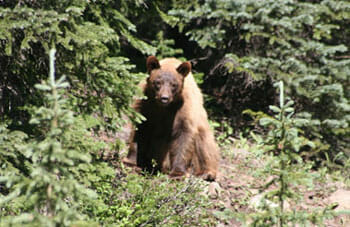
The American black bear (Ursus americanus), or simply black bear, is a species of medium-sized bear which is endemic to North America. It is the continent’s smallest and most widely distributed bear species. It is an omnivore, with a diet varying greatly depending on season and location. It typically lives in largely forested areas; it will leave forests in search of food and is sometimes attracted to human communities due to the immediate availability of food.
Black bears live in the wild mountain landscape of Chimney Rock National Monument in southwestern Colorado, alongside other native wildlife like mule deer, elk, and bobcats.
Wildlife and Habitat
Natural Range: The 4,726-acre national monument provides a rich forest and rocky environment suited for black bears.
Historical Presence: Ancient Ancestral Puebloans who inhabited the area centuries ago also shared the land with local wildlife, with historical bear remains found at the site indicating cultural significance.
Mountain Bobcat
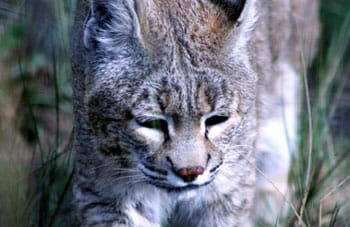
The bobcat (Lynx rufus) is a wild cat native to North America, characterized by its short “bobbed” tail, spotted coat, and tufted ears. They are adaptable animals found in rocky mountain foothills, brushlands, and forests.
Mountain bobcats are native, elusive feline residents of Chimney Rock National Monument in southwestern Colorado, sharing the rugged canyon ecosystem with mule deer, elk, and black bears.
Physical Traits
Size: Total length ranges from 28 to 37 inches.
Weight: Adults typically weigh between 15 and 35 pounds.
Appearance: Grayish-brown to tan fur with black spots, facial ruffs like sideburns, and a stubby 4 to 6-inch tail tipped with black.
Terrain: Thrive in rocky outcrops, rimrocks, canyons, and dense brush.
Denning: Use caves, boulder fields, and hollow logs for shelter and raising young.
Diet: Primarily hunt rabbits, hares, rodents, and birds.
Behavior: Shy and secretive, rarely seen by human visitors.
Role: Act as native predators helping control small mammal populations.
Mule Deer

The mule deer (Odocoileus hemionus) is a deer indigenous to western North America; it is named for its ears, which are large like those of the mule. Two subspecies of mule deer are grouped into the black-tailed deer. Mule deer are found only on the western Great Plains, in the Rocky Mountains, in the southwest United States, and on the west coast of North America.
Mule deer are common inhabitants of Chimney Rock National Monument in southwest Colorado, serving as an important part of the local ecosystem and a frequent sight for visitors.
Seasonal movement: Migratory mule deer herds pass through the monument’s ponderosa pine forests and valleys during their spring and fall migrations.
Winter range: The rugged terrain and surrounding landscape provide critical winter range habitat for local deer populations.
Historical presence: Ancestral Puebloans who lived at the site relied on the area’s rich wildlife, including large game like mule deer and elk.
Elk
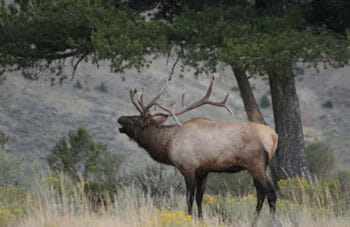
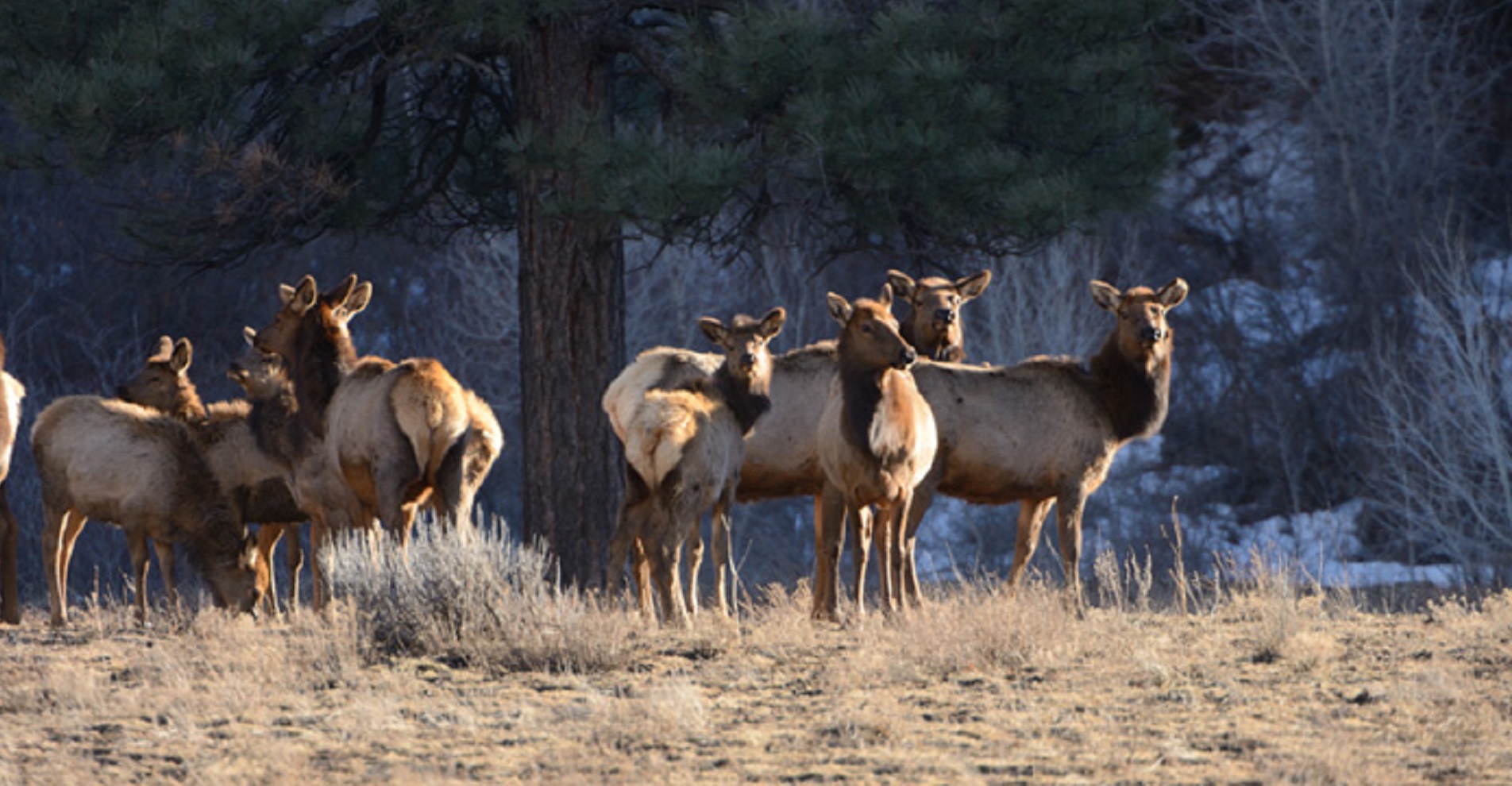
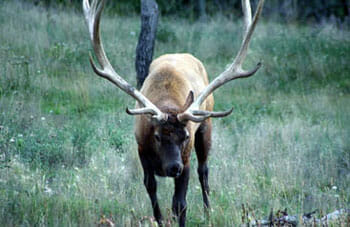
The elk (pl.: elk or elks; Cervus canadensis) or wapiti (pronounced /ˈwɒpəti]) is the second largest species within the deer family, Cervidae, and one of the largest terrestrial mammals in its native range of North America and Central and East Asia. The word “elk” originally referred to the European variety of the moose, Alces alces, but was transferred to Cervus canadensis by North American colonists.
The name “wapiti” is derived from a Shawnee and Cree word meaning “white rump”, after the distinctive light fur around the tail region which the animals may fluff-up or raise to signal their agitation or distress to one another, when fleeing perceived threats, or among males courting females and sparring for dominance. A similar trait is seen in other artiodactyl species, like the bighorn sheep, pronghorn and the white-tailed deer, to varying degrees.
Elk dwell in open forest and forest-edge habitats, grazing on grasses and sedges and browsing higher-growing plants, leaves, twigs and bark. Male elk have large, blood- and nerve-filled antlers, which they routinely shed each year as the weather warms. Males also engage in ritualized mating behaviors during the mating season, including posturing to attract females, antler-wrestling (sparring), and bugling, a loud series of throaty whistles, bellows, screams, and other vocalizations that establish dominance over other males and aim to attract females.
Migratory elk herds use Chimney Rock National Monument in southwestern Colorado as a seasonal migration corridor and critical winter range.
Elk and Wildlife Facts
Migration Timing: Herds pass through the area during the spring and fall.
Historical Presence: Ancestral Puebloans hunted elk and used their resources in the high-elevation landscape.
Red Fox
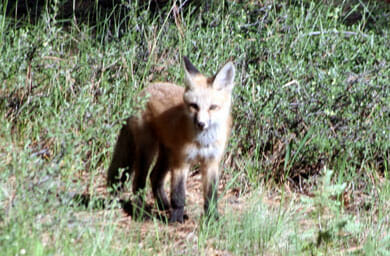
The red fox (Vulpes vulpes) is the largest of the true foxes, and the most widely distributed member of the order Carnivora. It is present across the entire Northern Hemisphere, including most of North America, Europe and Asia, as well as parts of North Africa. Its range has expanded alongside human settlement.
The red fox is one of the native mammal species living in Chimney Rock National Monument in southwestern Colorado.
Appearance: Reddish-yellow coat with dark back and shoulders, and a distinct white tip on its tail.
Habits: Mostly active at dawn, dusk, or night; they eat small rodents, rabbits, and plants
Prairie Dog
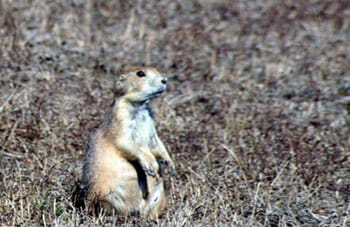
Prairie dogs live in the grassland and mountain shrub areas of Chimney Rock National Monument in southwestern Colorado.
Habitat and Location
Where they live: Found primarily in the grassland habitats located in the northern and eastern sections of the monument.
Behavior: These social burrowing rodents live in underground colonies and use sharp alarm barks to warn others of approaching people or predators
The biologically rich mountain zone of Chimney Rock sported a variety of wildlife during habitation by the Ancestral Puebloans. Many of these native/wild species are still evident today.
Enjoy this gallery of common reptiles in the Chimney Rock National Monument:
Prairie Rattlesnake
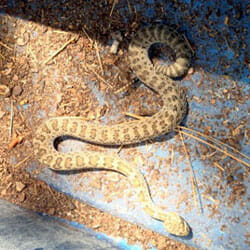
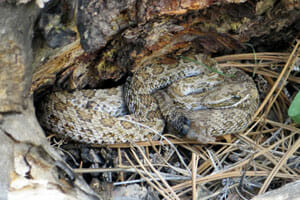
The prairie rattlesnake or Great Plains rattlesnake (Crotalus viridis) is a venomous pit viper species native to the western United States, southwestern Canada, and northern Mexico. Currently, two subspecies are recognized, including the prairie rattlesnake, the nominate subspecies, and the Hopi rattlesnake.
Prairie rattlesnakes are native wildlife inhabitants of Chimney Rock National Monument in southwestern Colorado. Visitors can minimize risks by watching the trail and avoiding rocky crevices.
Safety Guidelines
Stay on trails: Walk only on designated paths and paved loops to avoid stepping near resting snakes.
Watch where you step: Do not place hands or feet into dark rock crevices, under logs, or against un-monitored brush.
Give space: If you encounter a rattlesnake, back away slowly and give it room to escape
Bullsnake
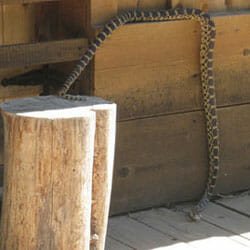
The bullsnake (Pituophis catenifer sayi) is a large, nonvenomous, colubrid snake. It is a subspecies of the gopher snake (Pituophis catenifer). The bullsnake is one of the largest/longest snakes of North America and the United States, reaching lengths up to 8 ft.
Bull snakes are native, non-venomous residents of Chimney Rock National Monument in southwestern Colorado, where they share the rocky, high-mesa ecosystem with other wildlife like the prairie rattlesnake.
Bull Snake Facts
Appearance: Heavy-bodied, yellowish with dark brown, black, or reddish blotches.
Size: Large snakes that can grow up to several feet long.
Behavior: Often mimic rattlesnakes by coiling, hissing, and shaking their tails in dry leaves or grass when threatened.
Role: Act as beneficial predators that help control rodent populations.
Smooth Green Snake (Mark Roper, USFS)
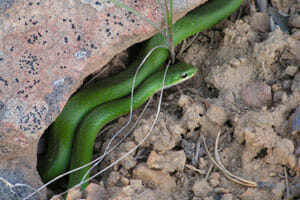
The smooth green snake (Opheodrys vernalis) is a species of North American nonvenomous snake in the family Colubridae. The species is also referred to as the grass snake. It is a slender, “small medium” snake that measures 36–51 cm (14–20 in) as an adult. It gets its common name from its smooth dorsal scales, as opposed to the rough green snake, which has keeled dorsal scales. The smooth green snake is found in marshes, meadows, open woods, and along stream edges, and is native to regions of Canada, the United States, and northern Mexico. A non-aggressive snake, it seldom bites and usually flees when threatened. It mates in late spring to summer, and females lay their eggs from June to September. The smooth green snake will often bob its head in order to mimic vegetation blowing in the wind.
The smooth green snake (Opheodrys vernalis) is a small, nonvenomous reptile native to the region and documented as part of the local wildlife at Chimney Rock National Monument in southwestern Colorado.
Snake Characteristics
Appearance: Bright grass-green back with a pure white or yellowish belly, growing 12 to 20 inches long.
Scales: Smooth dorsal scales lacking ridges (keels), giving the snake a sleek look.
Diet: Consists mainly of soft-bodied insects, spiders, caterpillars, and crickets
Collared Lizard
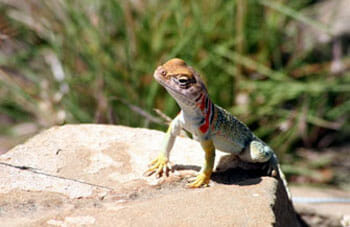
Collared lizards are vibrant, colorful reptiles living in southwestern Colorado’s Chimney Rock National Monument, recognized by their distinct dark neck rings.
Appearance and Behavior
Bright colors: Males have green-to-teal bodies with striking yellow heads, while females are brownish-green.
Distinct collar: Both males and females feature a bold, dark band around the neck.
Active sun bathers: They love to climb and rest on warm rocks during sunny days to absorb heat.
Fast runners: They can run very quickly on their back legs when scared.
Horned Lizard
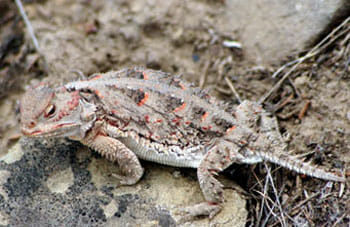
Horned lizards are native reptiles that inhabit the rocky, mountainous, and forested terrain of Chimney Rock National Monument in southwestern Colorado. They share this protected ecosystem with other local reptiles like the collared lizard, bull snake, and prairie rattlesnake.
Habitat and Behavior
Environment: Found basking on warm rocks and sandy patches.
Diet: Feed primarily on insects like ants and beetles.
Predators: Often hunted by larger local reptiles, including the fast-moving collared lizard.